
 EN
EN



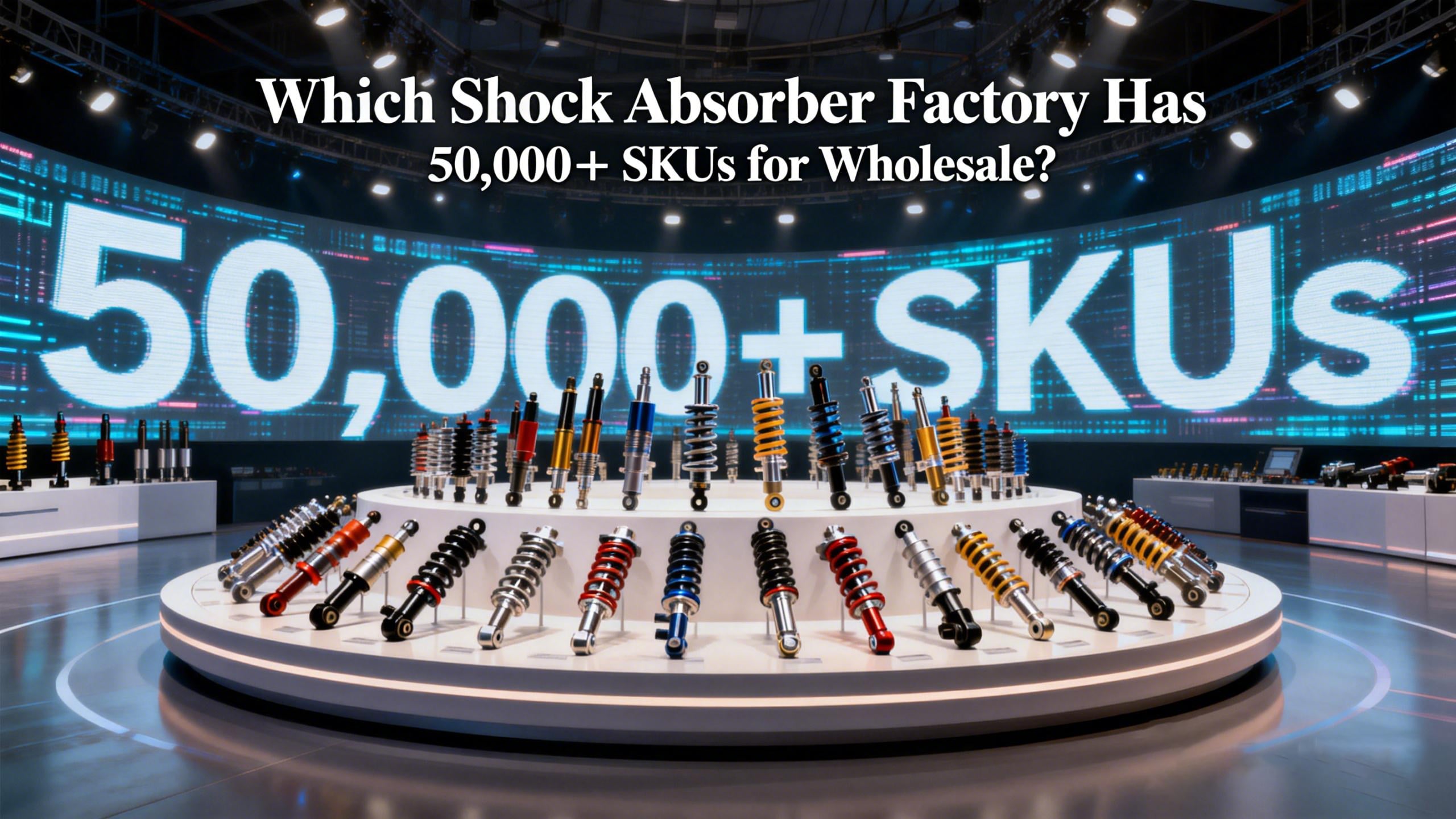
What '50,000+ SKUs' Really Means for Shock Absorber Wholesale
SKU Definition in the Shock Absorber Industry: Part Numbers, Variants, and Application-Specific Configurations
In wholesale distribution, a SKU (Stock Keeping Unit) is a distinct product identifier—not just a generic part number. For shock absorbers, this includes:
- Unique part numbers, distinguishing hydraulic, mono-tube gas-charged, twin-tube, and electronically adaptive designs
- Variant codes, specifying stroke length, valving profiles, mounting hardware (e.g., eyelet vs. clevis), and rebound adjustability
- Vehicle-specific configurations, engineered to match exact year/make/model/trim combinations—including suspension geometry, load rating, and OE calibration requirements
This precision enables reliable sourcing: a single vehicle platform may require 12+ SKUs due to trim-specific damping tuning or axle-load differences. Industry data shows an average of 4.2 application-specific variants per core part number—explaining how rigorously segmented catalogs legitimately exceed 50,000 SKUs without redundancy.
Verified vs. Claimed Scale: How Leading Shock Absorber Factories Report Inventory Breadth
Many suppliers advertise “50,000+ SKUs,” but only tier-1 manufacturers substantiate that scale through third-party verification. Audits assess three critical dimensions:
- Physical inventory turnover against stated SKU counts—not just database entries
- Cross-referencing accuracy against OEM technical documentation and service bulletins
- Concurrent fulfillment proof, including real-time order history across multiple regions
A 2023 Automotive Aftermarket Report found just 17% of suppliers making “50,000+ SKU” claims maintained >90% on-time, first-attempt fulfillment rates. Authentic high-volume factories achieve this not by stockpiling every variant, but through vertically integrated platforms—enabling rapid configuration of application-specific units from shared base architectures. This balances breadth with responsiveness.
Top Shock Absorber Factories with Verified High-SKU Wholesale Capacity
Global Tier-1 Suppliers: Tenneco, KYB, and Bilstein’s OEM-Backed Catalog Depth
Tenneco (including Monroe), KYB, and Bilstein exemplify verified scale: each maintains catalogs exceeding 50,000 SKUs through deep OEM integration. One such manufacturer produces over 50 million shock absorbers annually across 32 global facilities—supplying original equipment for major automakers while maintaining strict OE dimensional, durability, and performance specifications.
This OEM-aligned foundation ensures precise coverage across passenger vehicles, medium- and heavy-duty trucks, and performance applications—delivering 98% first-match accuracy for wholesale distributors. Their automated cross-referencing systems map part numbers across regional vehicle platforms and model years, reducing fulfillment errors by 40% compared to smaller, less-integrated catalogs (Automotive Logistics, 2023).
High-Volume Asian Shock Absorber Manufacturers: Nanyang Xijian and Wanxiang Qianchao’s Scalable Platforms
Nanyang Xijian and Wanxiang Qianchao combine high-volume manufacturing with agile SKU management—supporting exports to more than 100 countries. Their vertically integrated supply chains enable rapid production of region-specific variants: from Japanese kei-car dampers to ASEAN-market commercial-vehicle shocks built for higher payload and rough-road durability.
Over 70% operate cloud-based inventory systems that dynamically align production schedules with real-time wholesale demand signals—cutting average lead times to under 15 days. ISO 9001-certified facilities demonstrate 99.7% order fulfillment for batches exceeding 10,000 units, enabling distributors to negotiate lower MOQs and leverage regional warehousing partnerships without compromising availability.
How Shock Absorber SKU Scale Translates to Wholesale Advantages
Faster Order Fulfillment, Cross-Referencing Accuracy, and Fleet-Scale Distribution Efficiency
Having access to a catalog with over 50,000 verified SKUs brings real world benefits beyond just looking good on paper. The wider selection means fewer instances of customers waiting for backordered items or dealing with special orders that take forever to process. This matters a lot when working with commercial vehicle operators who need parts right away for their daily operations. Imagine handling an order that includes everything from small car suspension components to heavy duty truck parts all at once. A supplier with extensive inventory makes life much easier for distributors needing to manage multiple product lines at the same time, cutting down on the headache of sorting through different shipments and paperwork.
Cross-referencing accuracy improves significantly with depth: suppliers who rigorously map OE and OES part numbers across global vehicle platforms minimize mismatches during order entry and picking. This precision reduces costly returns, mis-shipments, and warranty disputes—especially important for wholesalers managing multi-regional inventories with varying compliance requirements.
Having verified SKUs makes it much easier to manage large scale distribution operations. Big distributors no longer need to deal with multiple small suppliers for different types of dampers like monotube gas charged ones, position sensitive models, or those with electronic adaptability features. Everything comes from a single source now. This consolidation really helps cut down on shipping expenses, saves time spent on paperwork, and reduces how often warehouses need restocking. The result? Logistics run smoother, products get delivered quicker, and there are far fewer instances where items go out of stock in the wholesale market.
Certifications and Supply Chain Rigor Enabling Reliable Shock Absorber Wholesale
Maintaining consistent quality across 50,000+ SKUs demands more than volume—it requires disciplined certification and resilient supply chain infrastructure. Leading factories implement ISO 9001-certified quality management systems to ensure dimensional repeatability, seal integrity, and damping consistency across every unit—regardless of application specificity.
Risk management gets even better when companies spread out where they get parts, track everything from the moment steel arrives until it becomes a finished product, and verify materials properly. This matters a lot right now because semiconductors are scarce and shipping around the world is unpredictable. When things go smoothly with these methods, factories don't shut down unexpectedly, which keeps those urgent wholesale orders moving along as planned. What's interesting is how strict quality control applies even to those tricky products nobody makes much of anymore. Think about old model parts or specialized components needed only in certain regions. Despite being rare items, these still hold up to the same tough standards car manufacturers demand. Distributors benefit greatly from all this too. They can count on having what customers need when they need it, face fewer problems with recalls, and know whatever part goes into inventory will fit just right, no matter how obscure it might be in the back pages of the catalog.
FAQ Section
- What is a SKU in the shock absorber industry?
- Why do shock absorber catalogs have over 50,000 SKUs?
- How do leading manufacturers verify SKU counts?
- What are the advantages of having a high-SKU wholesale capacity?
- How does quality control influence shock absorber wholesale?
A SKU (Stock Keeping Unit) in the shock absorber industry refers to a unique product identifier that includes part numbers, variant codes, and vehicle-specific configurations.
Shock absorber catalogs exceed 50,000 SKUs due to the various application-specific variants required for different vehicle models, trim specific damping tuning, and axle-load differences.
Leading manufacturers verify SKU counts through third-party audits focusing on physical inventory turnover, cross-referencing accuracy, and concurrent fulfillment proof.
Having a high-SKU wholesale capacity ensures faster order fulfillment, improved cross-referencing accuracy, and fleet-scale distribution efficiency for wholesale distributors.
Strict quality control ensures dimensional repeatability, seal integrity, and damping consistency across all SKUs, reducing recalls and improving distributor reliability.